Categories
Behaviour Management

3 Questions and 2 Strategies for Defiance

Defiance is a common challenge for teachers. Being honest, it’s a downright pain. You’ve planned out what you want to do and now they’re not cooperating. Maybe, you have an immediate need to complete a task and they’re refusing. It is excruciatingly frustrating. Unfortunately, there is no one-size-fits-all solution to defiance. Behaviour can be the result of a myriad of reasons and emotions. However, there are three questions you can ask yourself and two strategies to consider that can help you get to the bottom of their defiance and win without fighting.

Three Questions

What are they defying?

This is a great place to start. Clearly defining a problem is an essential first step in solving a problem. Defiance isn’t necessarily the problem. If a teacher asks a child to jump out the window and the child defies them, that’s an intelligent decision. 

I would advise the teacher to create a physical or mental record of instructions the child is defying. If a teacher can see a high volume of defied instructions, it could be a sign that they are over-instructing the child. Is there a need to have so many direct instructions? Think of your direct instructions as a finite resource for the day. Keep them to a small number so they’re more likely to be followed. Alternatively, the child might be refusing to engage with a certain subject or type of work? This will give the teacher crucial feedback when it comes to choosing a strategy. Perhaps it’s too difficult or doesn’t interest them. Search for patterns.

Why are they defying?

I like viewing behaviour through the lens of emotion. There’s a theoretical perspective that states behaviour is the result of pleasure, pain, fear or anger. I love this view as it is easy for teachers to grasp without extensive training. When the child is defying an instruction, are they defying because they get pleasure from the attention? Are they afraid of failing? Are they angry at not having their opinion listened to? Do they feel the pain of being unable to do the work in front of their peers?

Depending on what the underlying emotion is, the strategy will be very different. It is critical to be curious when faced with challenging behaviour as opposed to judgemental.

Is the instruction worth it?

If you are teaching an extremely defiant child, this question should be your go-to. The answer may be yes, but the answer is often no. I often do this, I bring an interaction close to a full-scale confrontation and then realise it’s over where they stand in a line or picking up a crayon they claim isn’t theirs. From reflecting on my teaching, I have come to realise that a lot of direct defiances can come from me trying to assert my authority needlessly, micromanage a child’s actions or providing minimal choice in their day.

Two Strategies

Choice and the language you use to instruct children prone to defiance are your best friends as they limit the situations where a child has only two options of yes and no. 

Choice

Distracting a child with simple choices can create win-win interactions where they are so preoccupied with choosing the seat they sit in and the colour pen you’ve offered them whether they respond to a topic with a poem, comic strip or comprehension that they are achieving the main objective you want them to. Here are three areas you can provide choice.

How they learn: The learning objectives are the core of the lesson. How they learn them isn’t. If you give a defiant child choice over how they achieve these objectives, there is less room for defiance. For example, let the child choose how they learn facts about a country. They could research online, they could read books from the library, they could watch videoes, they could listen to audio about the country. The only limit is the amount of choice you are willing to prepare.

Where they learn: If you are unable or unwilling to change the task, let them choose the location. Allow them to choose from a variety of locations. Perhaps they want to sit beside a friend. Maybe they want to sit at the teacher’s desk. Could they sit at a table alone? The key is to build the trust that by allowing them this choice, they are agreeing to engage with the task. You are allowing them control over the less important things so you control the most important: what they learn.

What they learn: This can be great for topics such as history where the topic is the Vikings, for example, and you allow them to choose what area they focus on. They could choose from weapons, food, clothes, day-to-day life. You set the framework that they must learn five new facts, but they are controlling what the topic they learn about is within that framework.

Language

The way you “sell” a task is crucial when working with an oppositional child. Everything needs to appear attractive, optional and fun (even if it isn’t). It takes a lot of practice to change the way you instruct a class but it can prevent problems before they arise. I taught a defiant child who would immediately engage in a full tantrum at the instruction of desk work. It was incredibly frustrating as I used to go to huge lengths to ensure the work was fun and within their ability. I overcame this through learning they needed to see some fun on the horizon. I started to preface all deskwork with a question to the general room, “Would anyone like to do P.E (or whatever was deemed fun) today?” to which all the hands would shoot up. I would then follow it with “Ok, we’ll get this quick task completed and then we can head straight down”. That small tweak in language made a huge difference as they saw the light at the end of the tunnel and were fully motivated. If I ever slipped back to direct instruction of desk work, defiance crept back in. Reflecting on and improving how you sell your instructions can improve compliance.

I’ll be the first to admit that defiance rubs me up the wrong way. Obedience is far easier to deal with. However, if we reduce the situation to the point that the child is not changing their ways and the teacher is not changing their ways, nobody is going to win. Making changes and incorporating choice is extra work and there can be an underlying urge to go toe-to-toe with a defiant child and try to assert your authority. I believe that winning without fighting is always a better solution, however, and the three questions and suggestions above can help you achieve this goal.

Like what you read?

Every Monday I send a short and free email with one strategy for behaviour, one for inclusion and one small thought, feel free to sign up here.


Processing…
Success! You're on the list.

Categories
Anger Management Behaviour Management Inclusion parenting

4 Key Questions Before Using Break Cards

Using break cards can be a fantastic strategy if a child is having a true meltdown when faced with work or a situation that they feel is challenging, new or too demanding. The Break Card is a simple, easy-to-use strategy that allows a child to opt-out of a task for a short time before reengaging with the situation afterwards.

Although the concept sounds simple, I have made numerous mistakes over the years trying to implement it successfully. It is easy to fall into the trap of designing an attractive card, laminating and displaying it without ever really putting in the groundwork to ensure it is a success.

To avoid the mistakes I made, here are four questions you need to answer clearly before using a Break Card successfully:

Who will supervise their break?

A fundamental principle of a break card is that the teacher has to honour it as soon as the child asks for it. If the child is opting to take a break, the teacher cannot tell them to wait for five minutes or that they “may” get it later when someone returns to take them. The teacher cannot decide that the child does not need it. Ensure that a break is granted instantly if you are implementing this strategy. If you do not have an extra pair of hands in the room, create an area inside the classroom for taking a break.

What will they do on their break?

Distractions techniques work best as a break. This can be engaging with one of their special interests. It can be breathwork. Their break can entail some light or intense exercise. The idea of the break card is that it is a true break. Make it engaging and take their mind off the task that was agitating them so when they return, they have rid themselves of any negative emotions.

What changes after their break?

This is an area that needs attention also. The work that was presented before the break was a trigger. It will still be a trigger after the break so teachers need to make a change. We can reduce the difficulty of the task. We can reduce the quantity of work. We can change how it is presented. Perhaps a worksheet could be changed to a similar task on an iPad? We can make it look less scary. A good rule to keep in mind is the 80/20 rule for children who find task completion difficult. Keep the first 80% of the task easy and achievable before having the final 20% as the challenge.

How will I implement the Break Card?

Take the time to explicitly teach how to deal with a task or situation that is new, challenging or too demanding. Teach them to:

  1. Try a little.
  2. Ask to watch someone else do it or ask for help.
  3. Take a break.
  4. Try again.
  5. Make a deal or negotiate how much has to be done.

We need to teach this repeatedly. Remind the child of it. Before assigning them a task, ask them how they are going to try it. Reward them when they follow the steps. It is so important to teach this skillset and then constantly remind them and reinforce it before they become stressed at a task. We do not let them tantrum to get their break. We ensure they ask for it calmly. Constantly reinforcing them for attempting difficult tasks despite whether they get the right or wrong answers will help them overcome their trigger point. The break card can be a key step in this process if harnessed correctly.

Like what you read?

Every Monday I send a short and free email with one strategy for behaviour, one for inclusion and one small thought, feel free to sign up here.
Processing…
Success! You're on the list.
Categories
Inclusion Special Education

9 Essential Questions for Children with Autism

Children with autism need extra support to be included in day-to-day life. The social cues, rules and routines that neurotypical children pick up without explicit teaching do not come as easily to a child with ASD. Without the appropriate support, these children may look to be “misbehaving” or “difficult” when really, they just require a helping hand to get involved and be included.

There are nine key questions when preparing a child with autism for a new event or skill:

  1. Where do I have to be?
  2. Who will I be with?
  3. Where exactly in the place will I be?
  4. What will be happening there?
  5. How much will I have to do there?
  6. How will I know when I have finished?
  7. What will I be doing next?
  8. What is the expected behaviour?
  9. What if? (questions guided by the child and their concerns)

If you are going to a school assembly later in the day, an adult should sit down with the child and move through the nine questions to ensure that the child knows exactly what is going to happen, how it will happen and what is expected of them specifically. This can prevent issues before they arise and prevention is always better than cure.

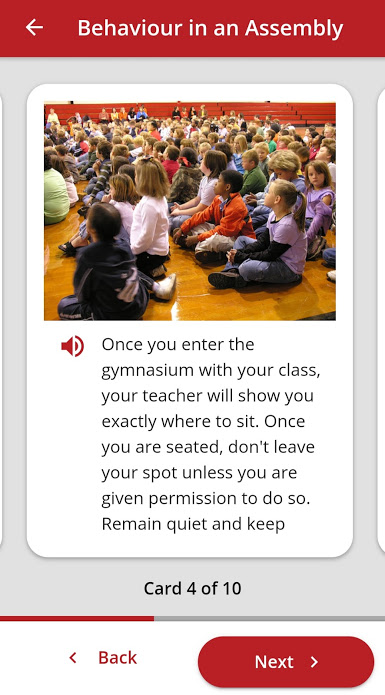
Visual resources like timetables and social stories benefit children with autism massively as it can reduce their anxieties by providing clarity. Timetables (app recommendation here) are easy to prepare and implement but having every single social story ready is not always possible. A lot of preparation can be required preparing a story about the event or skill you are trying to teach. They are extremely worthwhile but how can you predict every change, social skill and event that will happen in a school year? You can’t and this is where MagnusCards come in.

MagnusCards is an app that has a wealth of scenarios and skills that answer a lot of the generic questions that will occur throughout a school day and home life. 

For example, if you want to teach a child how to come in from lunchtime, there is a 10 picture story on how to do this. Want to teach a child how to engage with pairwork in a class? There is a 7 picture story that can be used.

The events and skills range from school to social skills to personal care and safety along with much more. The pictures and text are not specific to your child’s school or home but the stories are readily accessible at your fingertips if you need them. 

I would recommend this app for three reasons. First of all, having a look through the app will help you predict what stories you could personalise, prepare and print in advance for your child. Secondly, when a change occurs or unforeseen event happens, you have a quick-and-easy visual aid to support the conversation you need to have to support a child with autism. Finally, if you see a child with autism acting inappropriately during lunchtime or somewhere unstructured, you can pull out the app and use a social story to incidentally teach an alternative way to behave in that scenario with clear, visual prompts. MagnusCards is an app that is simple, free and practical. These apps are always welcome in a teacher’s toolkit.

To download MagnusCards:

Android Version here.

Apple Version here.

Like what you read?

Every Monday I send a short and free email with one strategy for behaviour, one for inclusion and one small thought, feel free to sign up here.

Processing…
Success! You're on the list.
Categories
anxiety Behaviour Management Inclusion parenting

The Difference Between Constructive and Destructive Anxiety Management

I came across some quality content from Dr. Tony Attwood on anxiety management related to children with autism. I love any information that is easy to understand and relay to people and has the potential to make a difference. This content fits the criteria.

Dr. Attwood discusses the two types of anxiety management. Constructive habits succeed in mitigating the potential impact of anxiety whilst destructive habits also does this but to the detriment of relationships with others. Dr. Attwood details three destructive strategies to avoid and promotes six constructive alternatives. If constructive strategies are not being used, a child may naturally fall into using destructive ones.

Three Destructive Anxiety Management Strategies

  1. Excessive Control: When children are feeling anxious, they may seek to exert control through defiance or threats to property, self or people. The impact this has on relationships is clear. Excessive control to manage anxiety may result in a diagnosis of Oppositional Defiant Disorder (ODD). Is this a reason to move away from labels? (Full article here)
  2. Rituals: An anxious child may insist on sameness and become intolerant and inflexible to any change. They can become over-reliant on rituals and routines when they are too prolonged detracting from their ability to engage in other tasks.
  3. Emotional Explosions: When fight-or-flight reaches a certain point, a child rife with anxiety may release the emotional energy pent up through an outburst which hurts others and damages friendships and relationships. This also takes an emotional toll on themselves in the aftermath.

Six Constructive Anxiety Management Strategies

These six strategies are necessities for anxious children. They are not rewards. The child requires them to engage with day-to-day life successfully. Analyse each one and consider if you are making the best use of each strategy.

  1. Physical Activity: Often underestimated, being physically active has a significant impact on anxiety. This can be through team sports, individual sports, movement breaks or walks. The options are endless and finding the medium that the child enjoys exercising through will aid them in coping with their anxiety.
  2. Relaxation: An anxious child has never relaxed just because they were told to. They have to be taught how to relax. This could be through a meditation app like Mindful Gnats (Android link here and Apple here), teaching the art of journaling, yoga or engaging in a range of activities depending on the child’s personality (Article: 6 strategies to help an anxious child here). A highly anxious child might never have learned to relax so it must be a priority to teach them.
  3. Special Interests: Allowing a stressed or anxious child to engage with their special interest is a powerful tool to relieve building anxiety. Depending on the interest, this can be easily implemented into day-to-day life. Allowing an anxious child with autism to engage with their special interest is not time wasted. It is time-efficient as they will be able to re-engage with activity after a short break.
  4. Favourite Person: An anxious child can experience relief when they are afforded some quality time with their favourite person. If the person is an SNA, teacher or child, this strategy can be utilised without extensive planning. If the person cannot be present, we can use audio messages, phone calls and emails. The child’s favourite person can be a great sense of comfort and relief.
  5. Diet: The benefits of a good diet go beyond the scope of this article. Needless to say that a balanced diet will have a positive impact on a child’s anxiety compared to a diet of junk food, sugar and refined carbohydrates.
  6. Sleep: Much like a healthy diet, we all can appreciate the positive effect of eight to ten hours of sleep on an anxious child. Weighted blankets, avoiding screen time before bed and a consistent nighttime routine can contribute to good sleep hygiene.

When you consider the child, ask yourself which type of strategies are being used to manage their anxiety. Are they destructive or constructive? Can we improve on how we use constructive habits? Which constructive habits can I control if I am a teacher or a parent? Focus on these and lean away from destructive behaviour.

Like what you read?

Every so often, I send short and free emails to 100s of subscribers with strategies for behaviour, inclusion and random thoughts, feel free to sign up here.

Processing…
Success! You're on the list.
Categories
Behaviour Management Special Education

What Toltec Wisdom Can Teach Us About Behaviour

Building relationships is a complex business. When we talk about teaching, behaviour and students, we are talking about a relationship. There are theoretical perspectives and strategies recommended to maximise the productivity of this relationship. Teachers may decide to take a behaviourist approach and incorporate rewards systems or may decide to take a more humanistic route and develop self-esteem. These approaches work for the majority of students when implemented effectively and the relationship between the two thrives.

When a relationship is unproductive, however, things get even more complex. Negative cycles of behaviour can emerge and patterns can stagnate. A repetitive format of the teacher intervening ineffectively and the student behaving undesirably appears fixed. Neither will change but only one party is being cited as difficult.

If a surgeon came out of a theatre and informed us that the operation was a success but the patient died, we might have a query about their rationale. Similarly, teachers (including myself) can get stuck in a rut of claiming their strategies and interventions are the “right” ones even though they are blatantly ineffective.

An effective behavioural strategy is one which causes the behavioural change it is seeking to achieve. Do I have to include that it also needs to be within obvious ethical parameters? Probably, as this is the internet.

There is a need to have a diverse range of strategies and theories to draw from when seeking to change a dysfunctional relationship into a functional one. Marrying yourself to one theory is comparable to only having a hammer in your toolbox. When all you have is a hammer, everything becomes a nail. You can descend into trying to fit the child into the strategy as opposed to fitting the strategy to the child. To demonstrate this point, we can take heed of the Toltecs.

The Six Images of A Relationship

According to Toltec wisdom, everyone has an outer image. This is the image we try to project to the world. We also have an inner image that we have of ourselves. Teachers have this outer and inner image. A student similarly has an outer image they try to project and an inner image that teachers and others cannot see. We then have to introduce the image that the teacher has of the student from their point of view and the student’s image of the teacher from their perspective. If you have managed to keep count, that is six different images involved in the relationship between teacher and student. Let’s not even start considering the rest of the class.

The first thing I love about this analogy is I find it relatable. I certainly have an image I try to project as a teacher. I try to project a level of confidence and certainty in my actions. I also have an inner image that differs greatly. My inner image has far more doubts than my outer image ever displays.

The second thing I love is the simplistic way that it conveys the complexity of a relationship. There are so many factors that remain unseen in a relationship between two people. How can we ever say with absolute certainty that we “know” a student and it’s not the intervention being used that is the issue, but the child? How can your favourite three strategies for supporting a child with complex social, emotional or behavioural needs ever be considered sufficient?

This interpretation of a relationship would jar with a fixed mindset that there is one or two theories or strategies for success. I’m sure if the Toltecs were in charge of behaviour policies in schools, they would recommend that schools and teachers strive to build their knowledge base with a diverse range of theories and strategies so when they meet a child that needs the support, there will be a deep well to draw from. A strategy’s use is defined by the behavioural change it causes. The more strategies we have, the greater the chance of success.

Like what you read?

Every Monday I send a short and free email with one strategy for behaviour, one for inclusion and one small thought, feel free to sign up here.

Processing…
Success! You're on the list.
Categories
Behaviour Management Homeschool parenting

How to Motivate Homeschoolers

By now, a lot of parents have their children at home and have either started or contemplated starting homeschooling. There is a lot of information out there right now which can be overwhelming. I believe that the number one priority is to maintain a happy and calm environment. If your child is feeling anxious, this needs to be addressed as soon as possible and I have written about potential solutions for anxiety along with a more extensive explanation of how to use journaling for this purpose also.

However, your child may be calm and, as a parent or guardian, you may be eager to engage them with some academic learning. The question is how to do this successfully? There are general principles that teachers use to encourage positive behaviour such as providing routine and choice and using a specific language. These are key to preventing misbehaviour before it has a chance to start. The next thing that is needed is motivation.

Extrinsic motivation

You may have heard your child talking about “points” they receive in school for being good. Perhaps, they can cash in these points for some kind of reward at the end of the day or week. Maybe, your child talks about their table being crowned “The Table of the Day” and they get to have some reward for their troubles. These are examples of the teacher extrinsically motivating the children. They are offering an external reward in exchange for a behaviour.

Parents can use this concept also to motivate their child to complete tasks and behave a certain way. There are 3 key principles that are necessary to ensure successful use of extrinsic motivators:

The Reward

The child has to be motivated by the reward on offer. It is not a reward just because you think it is. Picking a true reward is a vital first step. Examples of rewards could be sweets, screen time, cooking their favourite dinner, getting to pick the movie, extra pocket money, going out with them to play their favourite game in the garden or anything that they love.

The Behaviour

Pick one or two very specific behaviours to reward and make sure the child knows what they are. Instead of rewarding “being good”, reward “sitting at the kitchen” and “answering five questions” or whatever you specifically want them to do. Once you have picked a desirable reward and one or two behaviours that the child is able to perform, you are setting yourself up for success.

The Frequency

Finally, you need to judge how often to reward your child. As a general rule of thumb, younger children need to be rewarded more frequently. If they write five sentences, they might need to get their reward straight away to maintain motivation. Older children are generally able to wait longer, so their reward could be additional time on a games console at the end of the day or even a special reward at the end of the week. The frequency of the reward needs to be decided by the parent based on their child’s ability.

Two Simple Examples of Successful Systems

Once you have decided on the three conditions above. You can decide how to package it to make it most attractive. Think of yourself as a salesperson and the more positive and excited you are about this new system, the more excited they will be! Presenting the new reward system so they can physically see their progress can be very motivating and can be very simply done with household items.

Using an empty jar, for example, you could mark a line on it with a pen or rubber band. Every time the child performs the behaviour, you could add pasta shells or lentils to the jar. Once they have filled the jar to the line, they can get their reward. The band can be made higher if you feel they can behave for longer or can be brought down lower if you feel they need to be rewarded quicker.

A jar and some lentils can help sell your system.

Here is an example of a visual way of presenting your reward system where the behaviour can be added and the reward. You may say they need to get 3-6 stars awarded depending on their age before they can get their reward.

A whiteboard or paper can be just as effective.

The opportunities are endless and you will find an abundance of options on how to “sell” your system. Make sure your three key principles are locked in first, however, as the success of your system will hinge on the quality of the reward, selection of the behaviour and the frequency of reward above all else.

Best of luck and please share any ideas you what you have found helpful so far or are thinking of trying!

Like what you read?

Every Monday I send a Newsletter with one tip for behaviour management, one for inclusion and one concept to get you thinking, feel free to sign up here.

Processing…
Success! You're on the list.
Categories
Behaviour Management

Coronavirus Kids

We are living in a strange time right now. In Ireland and many other countries, we have been thrust into school closures with the advice of keeping children apart to ensure that coronavirus does not spread. This places sudden and sizeable stress on parents and children alike. Although we could see school closures coming, it came quite fast and children may be at home now with no real school guidance on what the best course of action is. Here are a few thoughts below that may be of help to parents or teachers:

Anxious Children

The media sells fear. This is a known principle of how media drives traffic to their websites and purchases of their newspapers. Anxious children do not need to be exposed to a 24-hour newsfeed about a virus they do not fully understand. Adults do not either. Limit the amount of coronavirus related media that children (and yourself) are exposed to. Limit the amount of talk about the coronavirus around children also. There is no need for children to listen to speculation, repeated reporting and scare-mongering which can be sure to contribute to their anxiety. 

Energetic Children

Children are advised not to mix with other children as they can help spread the disease to the more vulnerable. If you have a child with ADHD, ADD or any abundance of energy, this does not mean that you have to lock them inside. The advice seems to suggest being outside is a safe environment. Go to big parks, fields, forests or anywhere in nature where you believe contact with others will be minimal. Teach your child the concept of social distancing like a bubble around other families and explore places that, otherwise, you might not have the chance to explore.

One of the best ways to maintain a calm, positive environment is to make sure a lively child gets an opportunity to burn off some of their energy. An ounce of prevention is worth a pound of cure and preventing misbehaviour before it has a chance to arise is always a good tip.

Remember: there is no such thing as bad weather, just bad clothing choices!

Educational Activities

As this is an unprecedented event, teachers and parents have been left scrambling at what to do. There has been a noble effort by schools and teachers to direct learning remotely but I believe this is not the way to move forward. 

The teacher may be able to provide some beneficial guidance on applications and websites to utilise or pages in books to complete but this is a wonderful opportunity for your child to experience one-to-one learning that they otherwise would not get.

I would suggest the following list of activities that would be a more beneficial way to spend the bulk of “educational time” while at home:

  • Play board games to teach strategic thinking and problem-solving.
  • Bake or cook dinners together to teach healthy living and weight in maths.
  • Writing out shopping lists for practicing spelling and handwriting.
  • Gardening to teach about science or geography.
  • Paint a fence or a wall to teach about fo
  • Get out into nature for geography and P.E.
  • Play with Lego, mechano or any other construction for science.
  • Get children to dress up in adult clothes for a fashion show for drama.
  • Clean bedrooms and re-organise the house to teach executive functioning skills.
  • Read to your child or have them read to you for English.
  • Listen to podcasts and talk about them for oral language.
  • Bring home a few empty cardboard boxes from the supermarket and let them loose with colours, sellotape and scissors for art.

There is a list of exciting opportunities to entertain, education and enjoy time with your children over the next few weeks. Creativity and energy are needed but the chance to teach your own child should be grasped with both hands. It’s also important to note that the whole world will be spending more time watching television and on screens at the moment and we should reflect this with our children. There is nothing wrong with binge-watching television right now to entertain ourselves in the evening when everyone is tired out.

Control the Controllables

There is very little in our control at the moment regarding the wider world but we can control our actions. The important things we need to impress on our children is that there is no need to panic or worry but there is a need to be careful. We should educate our children to:

  1. Wash their hands with correct technique frequently.
  2. Cough into their elbow.
  3. Practice social distancing.
  4. Avoid mixing with their friends in person (encourage calling their friends on phones).

After these four points, there is very little else we can do right now other than take the positives where we can and enjoy the extra quality time with our loved ones. 

Categories
Behaviour Management

Making a game of Good Behaviour

There are many reward systems and strategies out there that claim to improve classroom behaviour. One system that comes with a bulk of evidence to support its claim is The Good Behaviour Game. This is a system which is proven to increase the desired behaviours and is relatively easy to implement: a win-win for teachers.

How to play

  1.  The teacher displays the list of desired behaviours in the classroom. As per best practice, these are few in number and positively phrased. They might include rules such as raising your hand to speak, eyes on the teacher when they are talking etc. 
  2. The teacher divides the class into groups with an even distribution of personality types (disruptive children, withdrawn children, studious children etc)
  3. The teacher initially plays the game for ten minutes daily for the first week. Teams get a point if they break a rule. If they have 4 points or more, they do not receive the reward. Visibly display the points so children can be reminded of the score and what is and is not acceptable.
  4. The teacher builds the amount of time the game is played for week after week. 
  5. The teacher slowly changes the rewards from immediate rewards – such as jellies, stickers or stationary – to deferred rewards such as additional free time at the end of the week, stickers, extra PE, access to iPads later in the day.

Key Considerations

Ensure that your rule list is small with simple-to-follow instructions. Ensure that the reward on offer is genuinely motivating to the target audience.

Do not overuse the strategy straight away, building up time slowly is essential to its success.

Changing the teams, times and rewards can manipulate the game to maintain interest over the course of a full-term if this is your desired strategy.

The beauty of the strategy is it can be explained in a very short time, does not require huge resources to implement and has research to back its effectiveness. 

Add it to the toolkit and pull it out when required. Enjoy!

Categories
Behaviour Management

How to End the Tale of Telling Tales

Teachers can have an aversion to children telling tales after lunch and break time. Children can feel the need to report every misdemeanour they have ever witnessed on the yard to the class teacher upon their return. Some students can be compelled to do this even after reporting it to the supervising teacher and watching as the teacher dealt with the situation. There are students out there that just love to retell the drama of it all. This is fine to a point and we always encourage children to tell a teacher if something bad has happened. The issue arises where you get every minute detail after every break and the issues are nothing more than minor indiscretions that could be handled by the supervising teacher or even better, sorted out amongst themselves. At times the motivation behind this type of behaviour can be to eat up teaching time as the lesson is side-tracked by sorting the incident or simply just students who love to stir up a bit of trouble.

When you try to prevent the telling of tales by silencing them or by ignoring the undesired behaviour, perhaps it gets worse or the children are too frustrated to concentrate on the next lesson. When you try to sort it out quickly, it can unravel and take ten or fifteen minutes to reach a satisfactory conclusion. What is an alternative strategy that you can incorporate to deal with this issue?

Listen: But on your terms and their time

I had a chronic issue with this type of behaviour with a class I taught before. It stemmed from their hyper-competitive nature (that I loved) but their games on yard often ended in petty disputes that they loved to report back after the bell which ate up precious teaching time. I used a simple solution to decrease this behaviour.

Having tried for weeks with various strategies to prevent their minor disputes with reflective discussions, preventive discussion and positive reinforcements with no success, I simply started to listen.

Whenever the students would come in from the yard and begin to sort out their disputes and tell tales on each other, I would feign the utmost genuine concern. I would ask who was involved and take careful note of the names. I would say that it sounds very important and we should try to get a solution to this issue. I would ensure to attribute no blame or showcase zero frustration. Then, I would tell them their appointment to sort this issue is at the start of the next break.

The children were initially very satisfied with this as I was demonstrating concern and was showing how I was willing to listen so the lesson could instantly begin that I had planned. The next break would come, and I would funnel the rest of the class out to the yard and suddenly, it would dawn on the remaining children that this issue could be resolved surprisingly quickly.

I would move comically slowly to my desk and take out my notepad and pen and begin to ask each child, “How can we solve this problem?”. I would take the spotlight away from the blame and focus it solely on what we could do to ensure it didn’t happen again. The students became antsy at missing their break time and could think of several ways to sort out their problems. It was miraculous how little they wanted to tell tales when it was on their time. When a satisfactory discussion was had (usually 4-5 minutes was enough), I would let them out without an angry word and tell them to enjoy their break.

Sure enough, I had to do this more frequently at the beginning, but very quickly the children realised that talking about many of their issues wasn’t worth five minutes of their own break time. They began to sort the minor issues out amongst themselves or tell the teacher on the yard and the constant telling of tales in my room reduced to zero.

It was a simple strategy that saved a lot of time. Of course, I missed time out of my break while using this intervention at the start, but I saved countless time over the year. If you’re struggling with a group that love to tell tales, I recommend it as a go-to strategy. Let me know if it works!

Disclaimer: Of course, bullying is always dealt with very seriously and students are always taught how bullying behaviour is deliberate, hurtful and repetitive. I trust a teacher will not use this strategy to reduce the reporting of bullying and knows the profile of their students appropriately to judge if this strategy is useful.

Categories
Behaviour Management

ADHD, ODD, ADD: Is labelling our children counter-productive?

One of my favourite thought-provoking articles I have read is a research paper by Nardone and Portelli titled When the diagnosis “invents” the illness. It is a fascinating take on the world we live in and how we classify mental disorders. It proposes a move away from the rigid categorisation of disorders and toward viewing problems as dysfunctional systems of perception and interaction.

Its implication for teaching children with social, emotional and behavioural difficulties would be a shift away from trying to fit children into a specific box such as ADHD, ADD, ODD, EBD etc which lead to predetermined strategies and instead focusing on a strategic approach where the problem is viewed on its own very specific merits and interventions are designed to help the student function better in their environment.

The paper makes a great case for this alternative way of thinking. It argues that a diagnosis has the potential to end up causing self-fulfilling prophecy and gives examples where this has been proven.

It gives one extreme example where a patient was admitted to the hospital as a manic depressive and was sedated with tranquillizers. The following day, she was to be moved to an alternative location but refused. The hospital insisted and the patient resisted. As they tried to forcibly move her, she became violent. She screamed. The doctor was called and a further series of injections were used to calm her as every time she woke, she became more violent.

This story may appear unpleasant but perhaps you may think “it was for her own good as she was manically depressed and they wanted to help her.” Your opinion may shift when you discover the police pulled over the ambulance when it was in transit to inform them that they had taken the wrong person. They had been injecting and sedating a “normal” person.

This story blew my mind. The nurses thought she was manically depressed so when she violently protested, they injected her as the diagnosis was there and the behaviour was interpreted as typical of the condition. How is this relevant to the classroom and students with social, emotional and behavioural difficulties? The story above is an extreme example but there are takeaways for us as teachers.

Let’s take for example a student with a diagnosis of attention deficit hyperactivity disorder (ADHD). A teacher who has a student with ADHD in their class may expect certain behaviours. They may expect the child to be disruptive, energetic, and inattentive and may treat them accordingly. The child – if they are aware of the diagnosis – may expect to perform these behaviours too. There is an element of diagnostic prophecy to the condition. 

With this diagnosis, common interventions include behaviour therapy and medication. To pose the question, what if the child has been wrongfully diagnosed and their behaviour was the result of something else and now they are being medicated?

Consider a child who is considered “normal” in your classroom. If a teacher is teaching a lesson and this child is inattentive and disruptive, the teacher might come to different conclusions. The teacher might consider their teaching. Was the child inattentive because the subject matter of the lesson was too difficult? Was the child disruptive because the methodology used was too boring and sedentary? The teacher may change the way they deliver future lessons to try to increase their engagement.

Is it possible that medically categorising our students at a young age might not be the correct way to go? Potentially. If a child with a diagnosis behaves a certain way, it can be accepted as part of their diagnosis. If a child without a diagnosis behaves a certain way, it may be more likely considered as communication.

I would not suggest throwing out all forms of diagnoses in schools, but I would be slower to label children in primary school and treat them a certain way because of their diagnosis. Thinking strategically (as discussed in previous articles) is a way to steer away from pigeon-holing our children and helping them to function more effectively in the classroom. The teacher can observe the problem behaviour specific to its characteristics and context and attempt to intervene to help the child function better in the classroom or wherever the problem may be. Having a diverse range of strategies, interventions and supports available is key to this way of thinking. 

I think this ideology is incredibly thought-provoking, how about you?